Fizz Mobile is a subsidiary brand of Quebec-based Videotron. As one of the more affordable alternatives to the Big Three (Telus, Rogers, and Bell), Fizz Mobile offers 5G and 4G LTE services in select areas of Canada. Unfortunately, its latest 5G expansion doesn't cover Canada from coast to coast, leaving many users relying on 4G LTE data speeds and domestic roaming (EXT) coverage. For EXT coverage, Fizz combines its own infrastructure with partner networks.
But it’s recently begun rolling out 5G service in select urban areas, adding a new layer to its long-standing 4G LTE coverage. Fizz Mobile's 5G access is currently available in Quebec, Ontario, Alberta, and British Columbia. However, its total 4G and 5G infrastructure does cover 99% of Canadians.
This guide breaks down where Fizz works best, how reliable its network is province by province, and what you should know about its emerging 5G capability.
Fizz Mobile coverage at a glance
Fizz Mobile is working on Videotron's network, with core services available in select provinces. Fizz Mobile provides 4G LTE service to over 97% of Canadians, with 5G services provided to select regions and hubs.
What we love
- Nationwide 4G LTE coverage
- Affordable pricing model
- My Rewards plan perks
What could be improved
- No Canada-wide 5G coverage
- Minimal coverage in remote areas
80/100
Where does Fizz Mobile have coverage?
Fizz Mobile operates differently from the major carriers because it uses a hybrid network model. It deploys its own infrastructure in core regions, particularly in Quebec. And it continues to expand across Ontario, Alberta, British Columbia, and Manitoba.
In Quebec, Fizz Mobile operates on Videotron's native infrastructure, which means strong, consistent service in major cities like Montreal, Quebec City, Gatineau, and surrounding regions. In Ontario, British Columbia, Alberta, and Manitoba, Fizz uses a combination of Freedom Mobile’s network (post-acquisition by Videotron) and roaming onto Rogers or Bell networks where Fizz’s native signal isn’t present.
For 5G coverage, Canadians can find the best coverage in Alberta, British Columbia, Ontario, and Quebec. Here, you'll find strong 5G support with the best speeds available on the network. On average, Fizz Mobile can support network speeds of up to 500Mbps.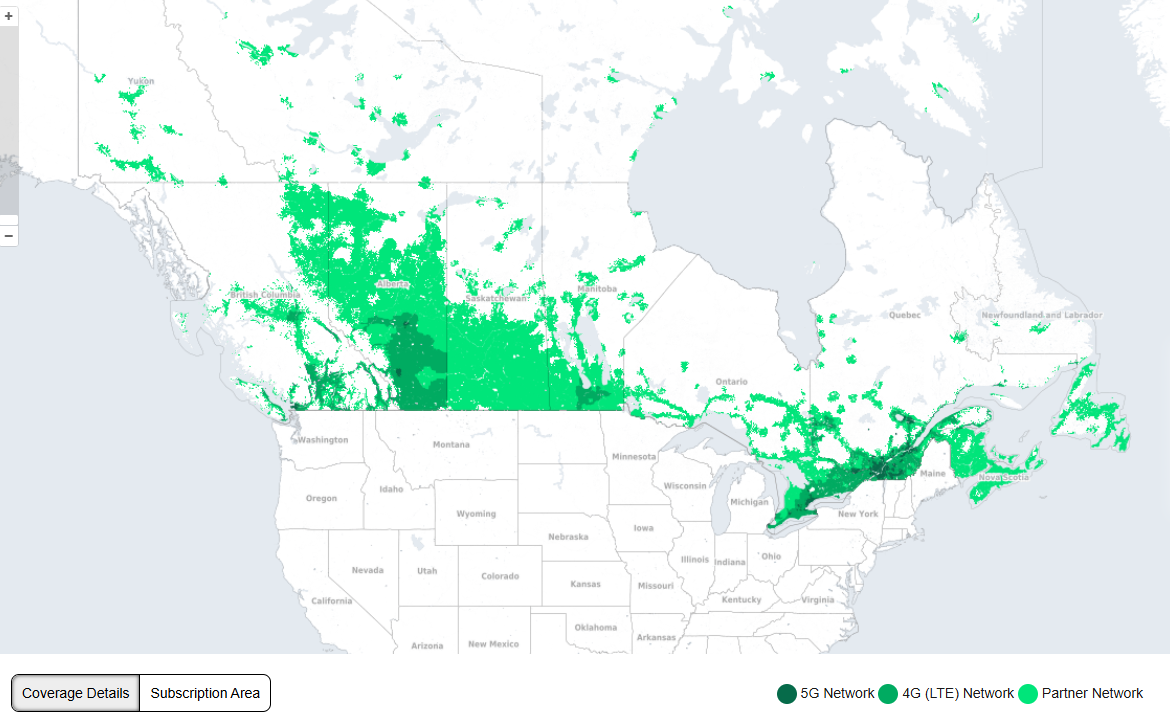
Image: Fizz Mobile
Virgin Plus reaches over 99% of Canadians, with strong coverage throughout most provinces, especially in metropolitan areas. Virgin’s total network coverage map only includes 36% of the country’s landmass, which is slightly behind Telus' coverage. Virgin Plus can be accessed across British Columbia, Alberta, Manitoba, Ontario, and all the way out towards the East Coast.
Before purchasing a Virgin Plus plan, you’ll want to check to see if its coverage area includes your household. You can do that with our coverage check or zoom in on your neighbourhood with our interactive map below.
Network coverage in Canada
| Carrier | Network | 5G coverage | 4G LTE coverage | Total network coverage |
|---|---|---|---|---|
| Fizz Mobile | Videotron | ~52.9% | 97% | 36% |
| Virgin Plus | Bell | N/A | 99% | 36% |
| Koodo Mobile | Telus | 70% | 99% | 37% |
| Public Mobile | Telus | 70% | 99% | 37% |
Is Fizz Mobile coverage reliable?
Fizz Mobile provides stable and reliable coverage, primarily in metro city hubs. Videotron is a Quebec-based provider, so Fizz LTE coverage is strongest in the province. Cities like Montreal and Quebec City see reliable LTE speeds that support your streaming, social media use, and any remote workflows without frequent drops.
In Ontario, for instance, Fizz Mobile supports 5G and 4G LTE within cities like Ottawa, Toronto, and Hamilton. In these centres, you’ll see stable connectivity similar to other flanker brands, though latency and speeds can vary in suburban and rural pockets when swapping over to EXT coverage.
In Alberta, British Columbia, and Manitoba, Fizz’s coverage is a mix of native signal and partner support. LTE service is generally reliable in urban areas like Calgary, Edmonton, Vancouver, and Winnipeg, though rural reception is less consistent. Unfortunately, this is common for budget carriers that swap to other networks for roaming.|
Fizz

Unlimited Canada Minutes & Text Messaging + 10GB Data Plan
$28.00/mth
+ $15 Upfront
|
|
Fizz
Unlimited Canada Minutes & Text Messaging + 150GB Data Plan
$45.00/mth
+ $15 Upfront
|
|
Fizz
Unlimited Canada + USA Minutes & Text Messaging + 100GB Data Plan
$48.00/mth
+ $15 Upfront
|
Fizz coverage in rural Canada
When it comes to rural coverage, Fizz Mobile’s reliability varies significantly depending on your province and proximity to major towers. Outside of Quebec, Ontario, Alberta, Manitoba, and British Columbia, Fizz Mobile leverages partnering networks to provide EXT coverage.
Fizz’s coverage in rural Canada is serviceable in many populated or near-populated areas, but you are more likely to lose signal or experience degraded performance than you would with the native Telus or Bell network carriers. If rural coverage is crucial for you and your family, choosing a carrier with a strictly native network (Bell, Telus) is still the safer bet.
Compare Fizz Mobile coverage
Fizz Mobile vs. Koodo Mobile coverage map

Image: Koodo Mobile
Koodo Mobile runs on the Telus network, giving it coverage that reaches 99% of Canadians and spans roughly 37% of the country geographically. That slight edge over Fizz Mobile shows up primarily in rural and northern regions, with a stronger signal across parts of the Yukon, Northwest Territories, and Nunavut. For Canadians living outside major metro areas, that expanded rural footprint can make a meaningful difference.
Koodo also has access to Telus’ 5G network, which covers approximately 70% of the population, a larger jump above Fizz’s own 5G. Over the past few years, Koodo has carved out a clear role as Telus’ value-focused brand, offering a mix of affordable prepaid options and competitively priced postpaid plans.
Check out some of the most popular Koodo plans available below.
|
#1
|
Koodo Mobile

$37.50 - No Tab/BYO Plan with 2GB Data
$37.50/mth
+ $10 Upfront
|
|
#2
|
Koodo Mobile
$55 - No Tab/BYO Plan with 60GB Data
$55.00/mth
+ $10 Upfront
|
|
#3
|
Koodo Mobile
$159 Prepaid 365 Day Plan
$159.00
Per 365 Day Top-up
+ $10 Upfront
|
|
#4
|
Koodo Mobile
$30 Unlimited Canada-Wide Calling Plan
$30.00
Per 30 Day Top-up
+ $10 Upfront
|
|
#5
|
Koodo Mobile
$60 - Happy Tab Lite Plan with 60GB Data
$60.00/mth
(after Auto-pay discount)
+ $10 Upfront
|
Fizz Mobile vs. Public Mobile coverage map

Image: Public Mobile
Public Mobile operates on the same Telus network as Koodo, which means its coverage map is virtually identical. That translates to reach across roughly 99% of Canadians, with 5G service available to about 70% of the population. As a Telus flanker brand, Public Mobile delivers reliable nationwide 4G LTE and growing 5G access at lower price points. You’ll find it especially appealing for budget-conscious and tech-focused users who don’t want to pay premium Big Three rates.
In terms of pure geographic footprint, Public Mobile’s coverage area is marginally larger than Fizz Mobile’s, spanning approximately 37% of the national map compared to Fizz’s 36%.
If you're looking for Public Mobile's 5G plans, we've gathered some of the most popular below.
|
#1
|
Public Mobile

$35 Unlimited CA-wide Talk + Text + 50GB
$35.00
+ $15 Upfront
|
|
#2
|
Public Mobile
$24 Unlimited CA-wide Talk + Text + 5GB
$24.00
+ $15 Upfront
|
|
#3
|
Public Mobile
$30 Unlimited CA-wide Talk + Text + 35GB
$30.00
+ $15 Upfront
|
|
#4
|
Public Mobile
$40 Unlimited CA-US Talk + Text + 70GB
$40.00
+ $15 Upfront
|
|
#5
|
Public Mobile
$22 Unlimited CA-wide Talk + Text + 1GB
$22.00
+ $15 Upfront
|
Cell phone coverage guides by province:
- British Columbia wireless coverage
- Alberta wireless coverage
- Saskatchewan wireless coverage
- Manitoba wireless coverage
- Ontario wireless coverage
- Quebec wireless coverage
- New Brunswick wireless coverage
- Nova Scotia wireless coverage
- Prince Edward Island wireless coverage
- Newfoundland and Labrador wireless coverage
Cell phone coverage by city:
- Vancouver cell phone coverage
- Edmonton cell phone coverage
- Calgary cell phone coverage
- Toronto cell phone coverage
- Ottawa cell phone coverage
- Montreal cell phone coverage
- Quebec City cell phone coverage
Steve Vegvari
Staff Writer

Thousands of cell phone plans unpacked. All the facts. No surprises.

Related Articles



Related Topics
5G Koodo Mobile coverage Public Mobile Fizz MobilePopular Topics
Android Apple Samsung iPhone Google iOS Cell phone plans Rogers Telus BellFind Better Phones and Plans
Hundreds of cell phone plans unpacked. All the facts. No surprises.