Fido runs on Rogers’ national network, operating as a mobile virtual network operator (MVNO). The carrier’s network delivers solid coverage across Canada with especially strong availability in major cities and any densely populated areas. Whether you’re commuting within the GTA, exploring Vancouver’s city core, or navigating Montreal’s urban sprawl, Fido customers should expect reliable performance for everyday calls, texts, and data use.
Fido's rural coverage continues to improve as Rogers expands its national footprint into more small towns, highways, and remote areas of the country. The network still has a few weaker pockets, including parts of Northern Quebec, Northern Ontario, and Canada’s far north. But Fido’s coverage reaches an estimated 97% of Canadians, making it a dependable option for most users.
Across this guide, we'll highlight Fido's 4G LTE coverage map and explain how it compares to some of the other carriers in Canada.
Fido coverage at a glance
In 2025, Rogers and Fido turned off the 3G/HSPA network. As of August, 3G-only phones and SIM cards are no longer supported on Fido's network. Fido also does not officially support 5G either, leaving Canadians to use 4G LTE services while under the carrier.
Fido provides affordable 4G LTE service to over 97% of Canadians. Fido’s coverage is limited in the rural, northern stretches of the country, though customers will be covered by Rogers Extended Coverage when venturing outside more densely populated areas.
What we love
- Affordable 4G LTE coverage
- 97% Access to the Rogers nationwide network
What could be improved
- No 5G access
- Unpredictable off-network coverage
80/100
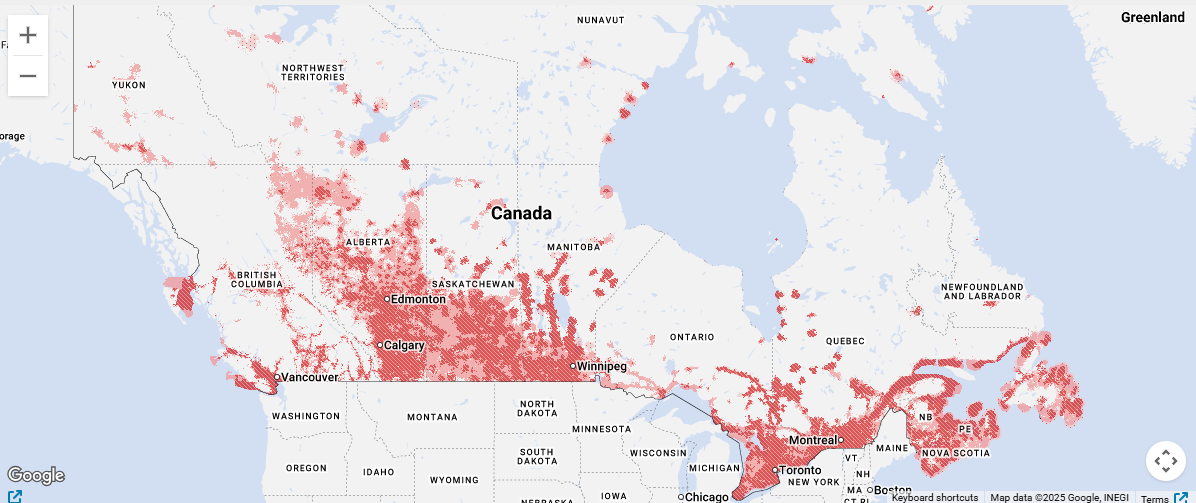
Fido coverage map

Credit: Fido
Fido operates on the Rogers network, which spans over 97% of Canadians. Cell phone coverage in Canada is determined by population and not by landmass, which is why Fido technically is only available across 28% of the country. Do not fear, though, as the Rogers network is available in populated areas across Canada, so too is Fido.
This access means that Canadians across British Columbia, Alberta, Saskatchewan, Manitoba, Ontario, and Quebec can all receive stable and reliable connectivity through Fido's services.Eastern Canada

Credit: Fido
Fido's services are generally strong and supported across Eastern Canada. All throughout Southern Ontario, throughout Kitchener, Toronto, Barrie and up towards Ottawa, customers can access Fido. The carrier's network extends out towards Montreal and out towards New Brunswick, Nova Scotia, and Prince Edward Island.
Western Canada

Credit: Fido
Out towards Western Canada, Fido's network continues to be very strong and accessible to Canadians. Across Vancouver, Edmonton, Calgary, Saskatoon, and Winnipeg, Canadians can find 4G LTE coverage from Fido. Unfortunately, the further north you go, the less likely you are to find coverage. The main exception to the rule is Alberta, which has coverage extending up towards the north.
Northern Canada

Credit: Fido
Fido barely touches Northern Canada. For the most part, true Fido service is not available in the Yukon, Northwest Territories, and Nunavut. However, Fido's Extended Coverage is available in some areas in the north. Unfortunately, it's not a reliable or sustainable solution to mobile services. Fido Extended Coverage provides slower 4G LTE speeds and spotty connectivity.
Compare Fido coverage to Rogers, Virgin Plus, and Koodo
Now that you’ve got a good sense of the Fido coverage area, let’s see how it compares with other cell phone carriers on the market.
Network coverage in Canada
| Carrier | Network | 5G coverage | 4G LTE coverage | Total land coverage |
|---|---|---|---|---|
| Fido | Rogers | n/a | 97% | 28% |
| Rogers | Rogers | 70% | 97% | 28% |
| Virgin Plus | Bell | 70% | 99% | 36% |
| Koodo Mobile | Telus | 70% | 99% | 37% |
Fido vs. Rogers coverage

Credit: Rogers
Rogers isn’t technically a Fido competitor. Rogers owns Fido and operates the company’s 4G LTE network. This setup means that wherever you can find Rogers' 4G LTE network, Fido should offer service as well.
The difference between the two carriers comes down to the pricing. Fido is generally cheaper, and that’s by design. Fido is a Rogers MVNO, or flanker brand, meaning it was designed to offer cheaper plans aimed at younger and more budget-conscious demographics. That said, Rogers offers Canadians more for a higher monthly price.
Rogers' network is far superior to Fido, both in terms of coverage and speed. Both carriers operate on the same 4G LTE network, meaning their 4G LTE coverage is identical. However, Rogers also has a large 5G network, with coverage reaching over 70% of Canadians. Unfortunately, Fido customers don’t have access to this 5G network.
If you want the reliability and faster speeds of the Rogers network, you’ll need to go with a Rogers plan. You can find the carrier’s best 5G plans below.

Fido vs. Virgin Plus coverage
Credit: Virgin Plus
Virgin Plus operates on the Bell network, which covers over 99% of Canadians and 36% of the map. Virgin Plus’ 4G LTE network is slightly larger than Fido’s, though not by much–by and large, the two carriers offer the same 4G LTE coverage area, most of which can be found in the urban centres of British Columbia, Alberta, Saskatchewan, Manitoba, Ontario, and Quebec.
In 2024, Virgin Plus pulled the plug on all of its 5G services. When active, Virgin Plus' 5G reached over 70% of Canadians with competitively priced plans. Unfortunately for Canadians, Bell decided against supporting 5G on its Virgin Plus brand.
Interested in seeing Virgin Plus’ 5G plans? Check out the most popular ones below.

Fido vs. Koodo coverage

Credit: Koodo
Koodo is an MVNO operating on the Telus network, reaching over 99% of Canadians and covering 37% of the map. Similar to Virgin Plus, Koodo’s 4G LTE network is slightly larger than Fido’s, with more coverage in the northern provinces. Koodo is another MVNO that offers 5G coverage to its customers.
Koodo’s 5G coverage reaches over 99% of Canadians, mostly in the metropolitan areas in the southern half of the country, with a footprint that’s nearly identical to Virgin Plus. Interestingly, 5G service is also available through Telus’ other flanker brand, Public Mobile, which offers prepaid 5G plans.
Want to see the best Koodo 5G plans? Check out the most affordable options below.

Fido's network speeds in Canada
Recently, I went hands-on with Fido's services in Canada. Over the course of a month, I tested Fido in Southern Ontario, seeing how the service was able to power my time in Toronto as well as in more rural areas in the province. Under the carrier's network, I attempted to power my workflow when out of my office, streamed content while on the go, and tested the download speeds.
Using Fido's 40GB Talk & Text plan, I found that as a heavy data user, 40GB might not be enough for me, but it can serve the average Canadian user just fine in scrolling social media and answering emails. Where I did find the carrier lacking was in its speeds. 4G LTE already feels antiquated as other carriers have already adopted 5G. Moreso, Fido struggled to support over 75Mbps speeds, even in metro areas like Toronto.
At times, I even saw speeds drop to as low as 1.45Mbps in rural areas. This directly impacts how fast I was able to upload video files, stream content on Netflix or Crave, and play games over the cloud.
Switch to Fido for reliable 4G coverage

Network reliability
All of Fido’s plans operate on the Rogers 4G LTE network, which was named the most reliable wireless network in Canada by Umlaut for the seventh year in a row. Though Rogers’ 4G LTE network might cover less ground than Bell’s or Telus’, Umlaut ranked its data and voice reliability against its competitors.
Fido also offers VoLTE, or Voice over LTE, which makes for an even more reliable network experience by enhancing the quality of phone calls, enhancing data and voice speeds, and avoiding drops in service when moving between LTE and Wi-Fi calling. There’s no extra cost for Fido VoLTE; in fact, your phone will automatically use it to enhance your experience, so long as you have a compatible device.
Fido offers coverage when you venture outside of its network, too. Fido Roam is available for international travellers, with U.S. plans available for $12/day and an international option available for $16/day.
If you want to see what the Fido/Rogers network looks like near you, you can check out in one of our geographic guides below.
Cell phone coverage guides by province:
- British Columbia wireless coverage
- Alberta wireless coverage
- Saskatchewan wireless coverage
- Manitoba wireless coverage
- Ontario wireless coverage
- Quebec wireless coverage
- New Brunswick wireless coverage
- Nova Scotia wireless coverage
- Prince Edward Island wireless coverage
- Newfoundland and Labrador wireless coverage
Cell phone coverage by city:
- Vancouver cell phone coverage
- Edmonton cell phone coverage
- Calgary cell phone coverage
- Toronto cell phone coverage
- Ottawa cell phone coverage
- Montreal cell phone coverage
- Quebec City cell phone coverage
FAQs
Steve Vegvari

Steve Vegvari is a 10-year writer in the gaming and tech space, writing for several Canadian publications. He's covered everything from the latest marquee games and hardware to smartphones, smart home devices, TVs, and smart lights. Steve emphasizes his love of weird, experimental tech while uncovering the pros and cons of the Canadian mobile market.
Steve Vegvari
Staff Writer

Thousands of cell phone plans unpacked. All the facts. No surprises.

Related Articles



Related Topics
Virgin Plus Fido Rogers Koodo MobilePopular Topics
Android Apple Samsung iPhone Google iOS Cell phone plans Rogers Telus BellFind Better Phones and Plans
Hundreds of cell phone plans unpacked. All the facts. No surprises.